NURS-FPX4055 Assessment 3 Disaster Recovery Plan – Step-by-Step Guide With Example Answer
The first step before starting to write the NURS-FPX4055 Assessment 3 Disaster Recovery Plan is to understand the requirements of the assignment. The first step is to read the assignment prompt carefully to identify the topic, the length and format requirements. You should go through the rubric provided so that you can understand what is needed to score the maximum points for each part of the assignment.
It is also important to identify the paper’s audience and purpose, as this will help you determine the tone and style to use throughout. You can then create a timeline to help you complete each stage of the paper, such as conducting research, writing the paper, and revising it to avoid last-minute stress before the deadline. After identifying the formatting style to be applied to the paper, such as APA, review its use, including writing citations and referencing the resources used. You should also review the formatting requirements for the title page and headings in the paper, as outlined by Capella University.
How to Research and Prepare for NURS-FPX4055 Assessment 3 Disaster Recovery Plan
The next step in preparing for your paper is to conduct research and identify the best sources to use to support your arguments. Identify a list of keywords related to your topic using various combinations. The first step is to visit the Capella University library and search through its database using the important keywords related to your topic. You can also find books, peer-reviewed articles, and credible sources for your topic from the Capella University Library, PubMed, JSTOR, ScienceDirect, SpringerLink, and Google Scholar. Ensure that you select the references that have been published in the last 5 years and go through each to check for credibility. Ensure that you obtain the references in the required format, such as APA, so that you can save time when creating the final reference list.
You can also group the references according to their themes that align with the outline of the paper. Go through each reference for its content and summarize the key concepts, arguments and findings for each source. You can write down your reflections on how each reference connects to the topic you are researching. After the above steps, you can develop a strong thesis that is clear, concise and arguable. Next, create a detailed outline of the paper to help you develop headings and subheadings for the content. Ensure that you plan what point will go into each paragraph.
How to Write the Introduction for NURS-FPX4055 Assessment 3 Disaster Recovery Plan
The introduction of the paper is the most crucial part, as it helps provide the context of your work and determines whether the reader will be interested in reading through to the end. Begin with a hook, which will help capture the reader’s attention. You should contextualize the topic by offering the reader a concise overview of the topic you are writing about so that they may understand its importance. You should state what you aim to achieve with the paper. The last part of the introduction should be your thesis statement, which provides the main argument of the paper.
How to Write the Body for NURS-FPX4055 Assessment 3 Disaster Recovery Plan
The body of the paper helps you to present your arguments and evidence to support your claims. You can use headings and subheadings developed in the paper’s outline to guide you on how to organize the body. Start each paragraph with a topic sentence to help the reader know what point you will be discussing in that paragraph. Support your claims using the evidence collected from the research, and ensure that you cite each source properly using in-text citations. You should analyze the evidence presented and explain its significance, as well as how it relates to the thesis statement. You should maintain a logical flow between paragraphs by using transition words and a flow of ideas.
How to Write the In-text Citations for NURS-FPX4055 Assessment 3 Disaster Recovery Plan
In-text citations help readers give credit to the authors of the references they have used in their work. All ideas that have been borrowed from references, any statistics and direct quotes must be referenced properly. The name and date of publication of the paper should be included when writing an in-text citation. For example, in APA, after stating the information, you can put an in-text citation after the end of the sentence, such as (Smith, 2021). If you are quoting directly from a source, include the page number in the citation, for example (Smith, 2021, p. 15). Remember to also include a corresponding reference list at the end of your paper that provides full details of each source cited in your text. An example paragraph highlighting the use of in-text citations is as below:
“The integration of technology in nursing practice has significantly transformed patient care and improved health outcomes. According to Morelli et al. (2024), the use of electronic health records (EHRs) has streamlined communication among healthcare providers, allowing for more coordinated and efficient care delivery. Furthermore, Alawiye (2024) highlights that telehealth services have expanded access to care, particularly for patients in rural areas, thereby reducing barriers to treatment.”
How to Write the Conclusion for NURS-FPX4055 Assessment 3 Disaster Recovery Plan
When writing the conclusion of the paper, start by restating your thesis, which helps remind the reader what your paper is about. Summarize the key points of the paper by restating them. Discuss the implications of your findings and your arguments. Conclude with a call to action that leaves a lasting impression on the reader or offers recommendations.
How to Format the Reference List for NURS-FPX4055 Assessment 3 Disaster Recovery Plan
The reference helps provide the reader with the complete details of the sources you cited in the paper. The reference list should start with the title “References” on a new page. It should be aligned center and bolded. The references should be organized in an ascending order alphabetically, and each should have a hanging indent. If a source has no author, it should be alphabetized by the title of the work, ignoring any initial articles such as “A,” “An,” or “The.” If you have multiple works by the same author, list them in chronological order, starting with the earliest publication.
Each reference entry should include specific elements depending on the type of source. For books, include the author’s last name, first initial, publication year in parentheses, the title of the book in italics, the edition (if applicable), and the publisher’s name. For journal articles, include the author’s last name, first initial, publication year in parentheses, the title of the article (not italicized), the title of the journal in italics, the volume number in italics, the issue number in parentheses (if applicable), and the page range of the article. For online sources, include the DOI (Digital Object Identifier) or the URL at the end of the reference. An example reference list is as follows:
References
Morelli, S., Daniele, C., D’Avenio, G., Grigioni, M., & Giansanti, D. (2024). Optimizing telehealth: Leveraging Key Performance Indicators for enhanced telehealth and digital healthcare outcomes (Telemechron Study). Healthcare, 12(13), 1319. https://doi.org/10.3390/healthcare12131319
Alawiye, T. (2024). The impact of digital technology on healthcare delivery and patient outcomes. E-Health Telecommunication Systems and Networks, 13, 13-22. 10.4236/etsn.2024.132002.
NURS-FPX4055 Assessment 3 Disaster Recovery Plan Instructions
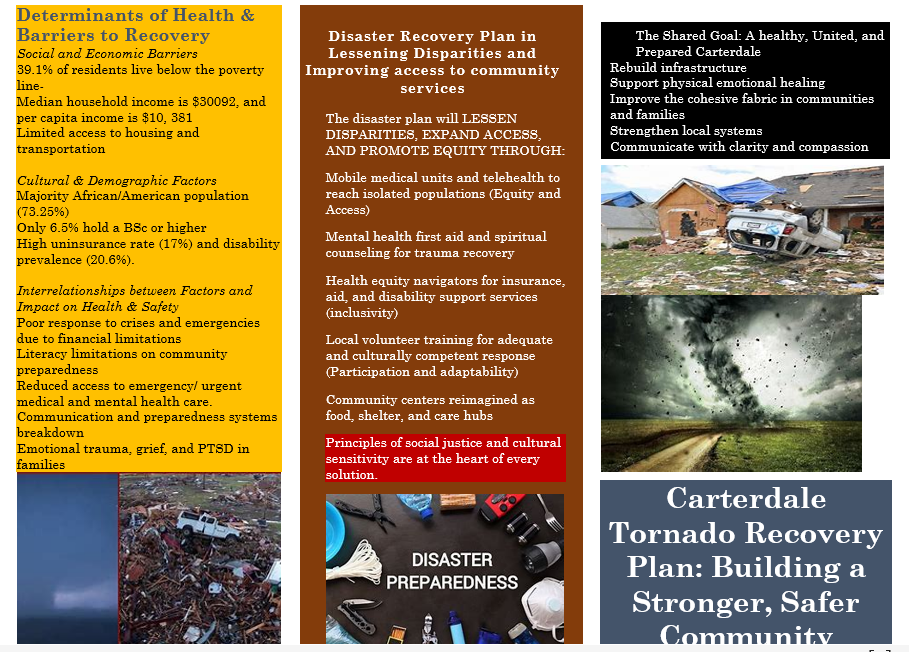
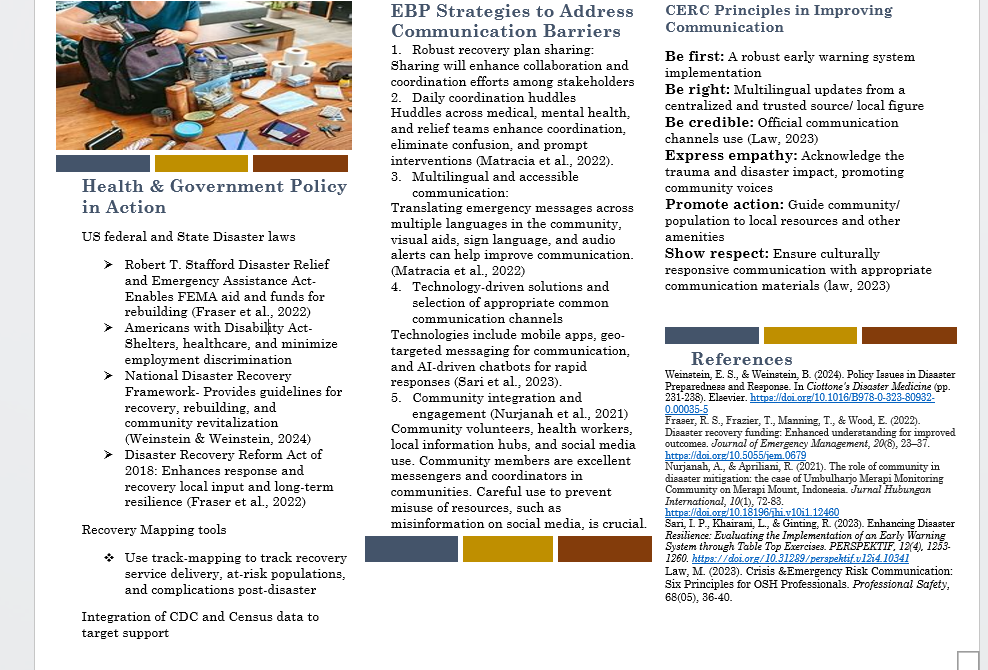
Develop a disaster recovery plan to reduce health disparities and improve access to community services after a disaster. Then develop a brochure, storyboard, or poster communicating the plan for the local system, city officials, and the disaster relief team.
Introduction
Nurses perform a variety of roles and their responsibilities as healthcare providers extend to the community. The decisions we make daily and in times of crisis often involve the balancing of human rights with medical necessities, equitable access to services, legal and ethical mandates, and financial constraints. In the event of a major accident or natural disaster, many issues can complicate decisions concerning the needs of an individual or group, including understanding and upholding rights and desires, mediating conflict, and applying established ethical and legal standards of nursing care. As a nurse, you must be knowledgeable about disaster preparedness and recovery to safeguard those in your care. As an advocate, you are also accountable for promoting equitable services and quality care for the diverse community.
A comprehensive recovery plan, guided by the Crisis and Emergency Risk Communication (CERC) framework and the National Incident Management System approach is essential to help ensure everyone’s safety. The unique needs of residents must be assessed to lessen health disparities and improve access to equitable services after a disaster.
Recovery efforts depend on the appropriateness of the plan, the extent to which key stakeholders have been prepared, quality of the communication, and the allocation of available resources. In a time of cost containment, when personnel and resources may be limited, the needs of residents must be weighed carefully against available resources.
In this assessment, you are a community task force member who is responsible for developing a disaster recovery plan for the community you have focused on in earlier assessments using the CERC for your crisis communication plan, which you will present to city officials and the disaster relief team. You will use the community from your windshield survey OR you may select a community from the document provided in this assessment.
Note: Complete the assessments in this course in the order in which they are presented.
Preparation
For this assessment, you will use the community from your windshield survey OR you may select a community from the Assessment 3 Supplement: Disaster Recovery Plan [PDF]. You will then develop a brochure, storyboard, or poster communicating the plan for the local system city officials, and the disaster relief team.
Instructions
Use the following steps to gather the information you need to create your disaster recovery plan. Then follow the grading criteria as the guide for what to include and how to structure your brochure, storyboard, or poster.
- Develop a disaster recovery plan for the community that will lessen health disparities and improve access to services after a disaster. Refer back to the community chosen for your health promotion plan.
- Assess community needs.
- Consider resources, personnel, budget, and community makeup.
- Identify the people accountable for implementation of the plan and describe their roles.
- Focus on specific Healthy People 2030 objectives.
- Include a timeline for the recovery effort.
- Focus on the following areas in your crisis communication plan:
- Information gathering.
- This is critical not only to promote situational awareness but also to receive feedback on messages and how they are received and interpreted. Media monitoring and analysis, including social media, is a central function because the media remains a source of timely information during any crisis. Close coordination with other response agencies and partners, and their public information officers (PIOs), to gather the most current information is also critical.
- Use the demographic data and specifics related to the disaster to identify the needs of the community and develop a recovery plan. Consider physical, emotional, cultural, and financial needs of the entire community.
- Information dissemination.
- This includes using a variety of channels to reach multiple audiences. These activities include general media relations, working with designated spokespersons, organizing news conferences, and providing briefings and updates. Inquiries and questions from the general public must also be addressed and should be documented through contact logs. In addition, officials and other key leaders must be briefed. These information dissemination activities should extend to web support and social media.
- Operation support.
- This involves a variety of communication activities, including addressing special needs and multilingual audiences through translation and other services. Facilities’ support activities involve ensuring sufficient communications capacity to support operations.
- Liaisons.
- They can provide two-way communication and coordination with key stakeholders and partners. Close coordination is necessary to achieve an effective response and create consistent messages.
- Provide support for your position.
- Include in your plan contact tracing of the homeless, disabled, displaced community members, migrant workers, and those who have hearing impairment or English as a second language in the event of severe tornadoes.
- Information gathering.
- Develop a brochure, storyboard, or poster of your disaster recovery plan. You can use one of the free templates available on the Brochure Design Templates web page, storyboard, or poster templates.
The requirements outlined below correspond to the grading criteria in the scoring guide, so be sure to address each point. Read the performance-level descriptions for each criterion in the scoring guide to see how your work will be assessed.
- Describe determinants of health and cultural, social, and economic barriers that impact community safety, health, and disaster recovery efforts.
- Consider the interrelationships among these factors.
- Explain how your proposed disaster recovery plan will lessen health disparities and improve access to community services.
- Consider principles of social justice and cultural sensitivity with respect to ensuring health equity for individuals, families, and aggregates in the community.
- Explain how health and governmental policy impacts disaster recovery efforts in a community.
- Consider the implications of legislation for community members such as the Americans With Disabilities Act (ADA), Robert T. Stafford Disaster Relief and Emergency Assistance Act, and 2018 Disaster Recovery Reform Act (DRRA).
- Consider trace-mapping the community progress during the recovery phase. (You can consult the resources in the Contact Tracing reading list for more information about contact trace-mapping.)
- Present specific, evidence-based strategies to overcome communication barriers and enhance interprofessional collaboration to improve disaster recovery efforts in a community using the CERC framework.
- Consider how your proposed strategies will affect members of the disaster relief team, individuals, families, and aggregates in the community.
- Identify evidence that supports your strategies.
- Organize content with clear purpose/goals and with relevant and evidence-based sources (published within 5 years).
- Make sure your choice of a brochure, storyboard, or poster is easy to read and error-free.
- Develop your assessment with a specific purpose and audience in mind.
- Adhere to scholarly and disciplinary writing standards and APA formatting requirements.
Supporting Evidence
- Cite at least two articles from peer-reviewed journals or professional industry publications within the 5 past years to support your plan.
- Include data from the CDC, United States Census Bureau, and other government agencies.
Before submitting your assessment, proofread your brochure, storyboard, or poster to minimize errors that could distract readers and make it difficult for them to focus on the substance of your presentation.
Note: If you require the use of assistive technology or alternative communication methods to participate in this activity, please contact DisabilityServices at Capella.edu to request accommodations.
Competencies Measured
By successfully completing this assessment, you will demonstrate your proficiency in the following course competencies and scoring guide criteria:
- Competency 1: Analyze health risks and healthcare needs among distinct populations.
- Describe the determinants of health and the cultural, social, and economic barriers that impact safety, health, and disaster recovery efforts in a community.
- Competency 2: Propose health promotion strategies to improve the health of populations.
- Present specific, evidence-based strategies to overcome communication barriers and enhance interprofessional collaboration to improve disaster recovery efforts.
- Competency 3: Evaluate health policies, based on their ability to achieve desired outcomes.
- Explain how health and governmental policy impact disaster recovery efforts in a community using the CERC framework.
- Competency 4: Integrate principles of social justice in community health interventions.
- Explain how a proposed disaster recovery plan will lessen health disparities and improve access to community services.
- Competency 5: Apply professional, scholarly communication strategies to lead health promotion and improve population health.
- Organize content so ideas flow logically with smooth transitions; contains few errors in grammar/punctuation, word choice, and spelling.
- Apply APA formatting to in-text citations and references, exhibiting nearly flawless adherence to APA format.
NURS-FPX4055 Assessment 3 Disaster Recovery Plan Example