



Module Handbook
Faculty of Business, Computing and Digital
Industries
School of Business
BMM5552: People Management
2026-27
Contents
Module Welcome………………………………………………………………………….. 2
Module Guide………………………………………………………………………………. 5
Module Code and Title……………………………………………………………………. 5
Module Leader Contact Details and Availability…………………………………….. 5
Module Team Tutors Contact Details and Availability……………………………… 5
Module Teaching…………………………………………………………………………… 5
Module Intended Learning Outcomes………………………………………………… 5
Summary of Content………………………………………………………………………. 5
Assessment and Deadlines……………………………………………………………… 6
Assessment Criteria…………………………………………………………………….. 10
Assessment Criteria Grid………………………………………………………………. 12
Resources…………………………………………………………………………………. 14
Academic Support……………………………………………………………………….. 14
Action Taken and Changes Made in Response to Student Feedback………. 15
Essential Library and Learning Resources………………………………………… 15
Race Equality……………………………………………………………………………… 15
Your Module at a Glance – Teaching and Assessment…………………………. 17
Your Module at a Glance – Employability………………………………………….. 20
Assignment Preparation Checklist…………………………………………………… 22
Module Welcome
Welcome to BMM5552: People Management
Hello and a very warm welcome.
I hope that you find this Module Handbook helpful in supporting your studies and that it provides you with all the information you need to know about this module. People management skills are one of the most sought after employee capabilities by businesses today. Companies realise that in order to survive and thrive in today’s environment, they need great people management (and organisational capabilities) which are different from those that helped them succeed in the past. Consider for a moment, if individuals in people management roles or positions of authority/power were not able to manage themselves (i.e., with meaning, purpose, ethics, integrity and inclusion), how then can they expect to manage others? In this context, the need to develop people management capabilities has never been more urgent.
People are considered to be an organisation’s most valuable asset. Successful companies know and value their staff; know that their employees are a crucial factor to their success; and they work hard to provide attractive pay and benefits, meaningful work, positive and inclusive work environments, and opportunities for growth and development.
On this module you will engage in lectures, seminars, and individual and/or group activities, in order to gain a critical overview of a range of people management concepts, theories, models and approaches, and critically evaluate their effectiveness. You will have opportunity to demonstrate team working and/or team management capabilities; ability to work productively to analyse and present complex information from research you have conducted; and ability to critically reflect on and appraise your team working/management abilities and identify areas for development.
This module will provide you with the tools to understand how the people management function of an organisation works, why, and how people and teams are deployed to further the business aims and strategy. The learning is very much led by yourselves, and so the success of this module and your experience, rests on your participation. Please enter into the process with positivity, enthusiasm and make the most of all activities and opportunities offered.
On the last page of this document, you will see your module at a glance. This document helps you understand your assessment, how it connects to your programme outcomes and to the graduate attributes (skills and behaviours) you will develop during your studies. This handbook is designed to help you understand what you have to do for this module and to explain why you are being assessed in a particular way. This will include how the learning you do, the teaching sessions you attend, and how the module assessment will support you in successfully completing your level of study.
All assessments included at your current level of study have been aligned against the programme outcomes to ensure you achieve these. These outcomes are included at the end of this document. We have designed your assessment so that it supports you to make meaningful connections across all the content you will study during this academic year. This handbook sets out the key assessments dates so you know when you will need to submit work and when you can expect your feedback. During this module, you will be asked to submit one piece of work for summative assessment. Further detailed information, assessment brief and in-depth guidance is available on Moodle under the section entitled ‘Assessment’.
On successful completion of your course when you apply for jobs you will be able to talk about a wide range of relevant transferable skills that you have developed in this module. This module will provide you with knowledge, skills, behaviours, and practical abilities, transferable to any potential management role and career, such as the ability to communicate effectively, manage people and resources to an agreed plan. You will also be able to demonstrate your ability to develop your people management abilities, through critical reflection, in response to the changing needs of your role, employer and our economy.
Arnauld Bobo
Module Leader
Module Guide
Module Code and Title
Module Code: BMM5552
Module Title: People Management
Module Leader Contact Details and Availability
Arnauld Bobo a.bobo@wic.ac.uk
Module Team Tutors Contact Details and Availability
Waqas Mehmood w.mehmood@wic.ac.uk
Olayide Olaosebikan o.olaosebikan@wic.ac.uk
Roya Rahimi r.rehimi@wic.ac.uk
Uzoechi Nwagbara u.nwagbara@wic.ac.uk
Module Teaching
Please refer to your Timetable
Module Intended Learning Outcomes
Upon completion of this module students should be able to:
- Appraise the effectiveness of a range of people management and leadership models, including those dealing with setting up teams.
- Recognise the role of the personnel and HRM specialists in public and private organisations.
- Demonstrate the ability of working within a team and reflecting on their personal skills and areas for development.
- Analyse and present complex information from research as part of a team.
Summary of Content
You will gain a critical overview of the role of the HRM function, and the practice of managing people, and how they both work together. You will gain a critical overview of a range of people management concepts, theories, models and approaches, and critically evaluate their effectiveness.
Activities involving people management skills (e.g., communication, negotiation, collaboration and co-operation, group/team-working) will develop your abilities. Activities involving individual critical reflection on your personal performance, will develop your awareness of areas for your future growth and development.
This module provides tools to understand how the HRM function and people management approaches of an organisation works, why, and how people and teams are deployed to further the business aims and strategy.
It is possible that there may be content or discussion within this course that may be difficult for some students. Please look to the module schedule to ensure you are aware of the broad subject content. The module team will flag especially difficult content proactively so that we ensure this classroom space is one that acknowledges that each of us will experience these discussions differently. There are a number of resources that can support you (include Student Space, Student Wellbeing or Samaritans). If you have any concerns about the content of a specific session, please inform the lecturer or a peer and seek support from Student Support who can be contacted via support@wic.ac.uk and via text/phone on 0207 0180 430 between 9 am – 5 pm Mon-Fri and 10 am-4 pm on weekends.
Assessment and Deadlines
| Component form (e.g. Essay or Online test) | Magnitude (e.g. 2,000 words or 2 hours) | Weighting and/or Pass/Fail | Assessment Deadline | Feedback Date | Module Intended Learning Outcome(s) assessed (e.g. 1, 2) |
| Individual report | 3,000 words | 100% | This Year | Feedback will be available on Moodle 15 days after the submission date (excluding national holidays, staff sickness and annual leave). | 1,2,3,4 |
Assessment Brief:
People management literature shows that effective people management is essential for organizational success, as it leverages the potential of employees to contribute to the attainment of strategic objectives (Lepak & Gowan, 2010).
- Critically discuss, analyse, and evaluate approaches to people management in practice in the organisational context, by using and applying theory, models, and approaches studied in this module to an organisation and/or a manager of your choice, to contextualise your analysis, critique, arguments, discussion, and conclusions.
- Your assignment may include the following structure:
- Introduction and context (500 words)
- Theoretical Framework (i.e., which theories (leadership theories, ethical theories, motivation theories, learning and development theories, diversity…etc) and why, justify your choices using examples and research evidence) (1000 words)
- Application of Theories, Analysis, and Discussion (i.e., how, you may link your selected theories with factors influencing their successful application) (1000 words)
- Conclusion and Recommendations (500 words)
- References
- List of Figures
- List of Tables
- Appendices
Word Count: The word count for written assessments is as noted above, +/- 10% is allowed. This does not include the references list, bibliography list, or appendices list. If you exceed the word limit, any work after the allowed wordcount will not be marked. Whilst you are not penalised for being under the word count, work that is substantially under the word count will be more limited in meeting the programme learning outcomes.
Feedback Date: Feedback will be available on Moodle 15 days after the submission date (excluding national holidays, staff sickness and annual leave).
Referencing: You are required to use the American Psychological Association (APA) referencing style. Please visit the Library guide here for more information APA 7th Referencing Guide – APA 7th Referencing Guide and here Referencing – Library at Leeds
Trinity University
All modules will include a session which unpacks the assessment brief, providing opportunities for you to clarify any questions you have about the assessment task. The assessment criteria and rubric will be examined in these sessions to support your understanding of the expectations of the task(s). Your module tutor will provide generic feedback on what a good assessment looks like, common misconceptions, pitfalls, construction of arguments, format, spelling and referencing. You are encouraged to bring selected sections of your work or a one-page plan to assessment support sessions for verbal feedback and where appropriate, peer discussion. Your module tutor will not give any indication of mark or classification for any draft work presented. Where you have received previous feedback, your tutors will encourage you to reflect on this to support your acquisition of knowledge and academic skills development. Feedback on a full draft of an assessment for submissions, prior to the submission deadline, is not normally permitted.
Use the Assignment Preparation Checklist on the last page before you submit your work.
Academic Integrity
Waltham International College, in partnership with Leeds Trinity University, is committed to fostering a diverse and inclusive environment where students are expected to act with integrity, self-discipline, and respect in all academic and professional activities. Academic Integrity refers to conducting scholarly work in an open, honest, and responsible manner. Students must respect the intellectual property of others by properly attributing and acknowledging sources. Through authentic learning, students are encouraged to develop independent thought and analysis, ensuring the academic standards and value of the University’s awards. It is the responsibility of students to ensure their work upholds these standards.
Academic Misconduct Academic misconduct involves any form of dishonesty in academic work, whether intentional or unintentional, that undermines the integrity of assessments. Any suspected misconduct will be investigated, and common types of misconduct include:
- Poor Scholarship: Incorrect referencing or misunderstanding of academic standards.
- Self-Plagiarism: Reusing one’s work without proper acknowledgement.
- Plagiarism: Using others’ work without citation.
- Collusion: Unauthorized collaboration on individual tasks.
- Fabrication: Falsifying data or manipulating academic documents.
- Research Misconduct: Failing to conduct ethical research.
- Impersonation: Allowing someone else to assume your identity for academic gain.
- Contract Cheating/Use of AI: Seeking assistance from a third party or using AI tools to complete your assignment.
Waltham International College and Leeds Trinity University are dedicated to investigating all instances of academic misconduct and applying appropriate disciplinary measures when necessary.
Use of Generative Artificial Intelligence in this module
- You may use generative AI such as ChatGPT to assist you in the process of undertaking the assessment in the following ways: brainstorming, research, planning, feedback, editing.
- All use of generative AI must be explicitly acknowledged, and any artificially generated content (e.g. images) explicitly labelled, with the source of the AI tool referenced using current APA referencing conventions You can find further guidance on the library website on their AI webpage).
- In submitting your assignment, you agree to disclose the extent to which you have used generative AI in preparing this work, and include evidence of your AI use in your appendices (e.g. dated screen shots of your use of this tool or copy and paste your AI chat into Word).
- Failure to disclose your generative AI use may result in a 0 for your assignment and a referral for academic misconduct (see the Student Academic Misconduct Policy under Essential Info in the MyLTU app).
You are required to include one of the following statements on your assignment:
Either:
- This assignment used generative AI in the following ways for the purposes of completing the assignment (choose 1 to 5 of the following): brainstorming, research, planning, feedback, editing.
Or:
- This assignment did not use generative AI for the purposes of completing the assignment.
Assessment Criteria
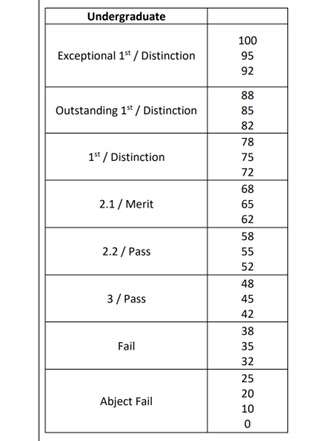
Your work will be assessed in line with the generic marking criteria for undergraduate assessments (see below). In common with many Universities, Leeds Trinity University employs categorical marking to all assignments and assessments. Marks are therefore awarded as follows: –
Work assessed as being of a first or outstanding first-class standard typically: –
- Answers all parts of the assessment task.
- Demonstrates deep and nuanced knowledge and understanding of contemporary developments at the forefront of the discipline(s) (i.e., theories, models, approaches, schools of thought, and research findings).
- Underpins throughout, with purposeful and systematic use of primary and/or secondary sources of literature and evidence. Shows sustained, clear, independent, and original thought, and a well thought out methodological approach.
- Includes extensive, selective, and evaluative use of research evidence, which is rigorously applied.
- Offers a sophisticated and highly nuanced argument and structure, which is perceptive, insightful, and original.
- Highly professional, succinct, concise and to the point writing, which is highly appropriate to the audience and discipline.
- Offers original, detailed, and perceptive analysis; rigorous and sustained critical evaluations and appraisals; and convincing, well-argued conclusions and recommendations (if appropriate to the assignment/assessment task). 8. Flawless referencing and use of other academic conventions.
Weaker work assessed as being a failure is often characterised by:
- Failing to read and understand all parts of the question/task.
- Failing to answer all parts of the question/task.
- Failing to underpin throughout with theory &/or academic sources.
- Demonstrating limited understanding of key concepts, issues, and debates, and showing little awareness of the complexity of the discipline.
- Demonstrating limited or inappropriate selection and use of primary and/or secondary sources of evidence, and little application of research evidence to underpin throughout.
- Offering a flawed basic argument or structure, with flawed or inaccurate writing, with limited awareness of the discipline, and the audience it is written for.
- Offering an overly/mainly descriptive approach, with little analysis and evaluations; with inconclusive unbalanced arguments; inadequately/weakly supported conclusions.
- Inaccurate flawed referencing, and poor use of other academic conventions. 9. Using essay writing services, plagiarising, and using non-academic and nonpeer reviewed sources of literature and evidence
Assessment Criteria Grid
| Generic descriptors to inform marking criteria for academic undergraduate assessments | ||||||||
| Classification: Criterion: | Exceptional 1st 100, 95 | Outstanding 1st 85 | 1st 75 | 2.1 68, 65, 62 | 2.2 58, 55, 52 | 3 48, 45, 42 | Fail 38, 35, 32 | Abject Fail 25, 20, 10, 0 |
| Knowledge & Understanding | Polished grasp of subject. Astute and authoritative approach to complexity. | Comprehensive and confident grasp with strong sense of subject complexity. | Thorough understanding evident and well applied to specific assessment task. | Secure, general understanding and reasonable application to assessment task. | Sound knowledge relevant to the assessment task. | Limited knowledge shows basic understanding. Some awareness o the context of the assessment task. | Faulty understanding of assessment task or concepts. Irrelevant or mostly absent content. | No understanding of assessment task or concepts. Irrelevant or absent content. |
| Structure, Argument | Effective and integrated over- arching argument or structure, clear, insightful synthesis. Highly creative understanding of topic | Effective overall argument with clear and insightful connections between claims. Creative understanding of topic. | Clear and logical focus and direction with valuable connections made between claims. Good level of creativity. | Well-focused on the question with some clear connections made between claims and some overall direction. Some creativity. | Addresses the topic with some direction and makes some connections between claims or different parts of artefact/assignment . | Argument is weak and difficult to detect. Connections made between statements limited | Lack of argument. Faulty connection between statements. | No argument. Many faulty connection between statements. |
| Analysis and Conclusions | Original and searching analysis, critical appraisal of task and judicious conclusions. | Searching analysis with pertinent conclusions drawn. | Insightful analysis throughout with appropriate conclusions drawn. | Strong analysis of salient illustrative examples. Some general conclusions drawn. | Some conclusions drawn based on some reasonable comparisons and examples. | Basic analysis. Remains descriptive, little evaluation or comparison. Few clear conclusions. | Insufficient evaluation or attempt to make comparisons. Conclusions illogical insufficient. | No evaluation or attempt to make comparisons. Conclusions illogical or absent. |
| Sources & Evidence | Extensive and evaluative use of evidential support for argument. | Extensive use of evidence with some evaluation. | Clear support of argument with well selected evidence. | Draws on relevant independent sources and evidence to support claims. | Makes simple use of evidence from recommended sources. | Relies on superficial statements with little supporting evidence. | Lack of evidence or relevant sources. | No evidence or relevant sources. |
| Adherence to Referencing Convention s, Technical Skills | Flawless referencing or technical skills. | Flawless referencing or technical skills. | Excellent referencing or technical skills. | Consistent and accurate referencing or technical skills. | Largely consistent accurate referencing. or technical skills. | Limited referencing/ adherence to convention or technical skills. | Inadequate referencing or technical skills. | Inadequate or no referencing or technical skills. |
Page 12 of 22
| Written/Visual/ Oral Style & Clarity | Professional and sophisticated with exceptional clarity and coherence. Excellent, controlled, confident delivery, pace, and audience engagement. | Professional and fluent with great clarity and coherence. Confident delivery, pace and audience engagement. | Fluent and accurate with great clarity and coherence. Mostly confident delivery, pace and audience engagement. | Clear and coherent. Good delivery, pace and audience engagement | Some lapses of clarity. Some expression is ineffective. Satisfactory delivery, pace and audience engagement | Adequate, but awkward expression throughout with little clarity. Poor delivery, pace and audience engagement | Inadequate and unclear presentation. Impaired communication. Error-strewn. | Grossly inadequate and unclear presentation. Severely impaired communication. Error-strewn. |
Page 13 of 22
Resources
The library holds several editions of many of the books you will find useful, but references are given here only for the most recent editions. Access to catalogues can be found on the
‘My LTU app’ or via the website: https://lib.leedstrinity.ac.uk
Core resources
- Moodle Page for the Module: https://moodle.leedstrinity.net/course/view.php?id=1017
- Library: https://lib.leedstrinity.ac.uk and phone number 0113 2837244
Core texts:
- Armstrong, M., & Taylor, S. (2020). Armstrong’s handbook of human resource management practice (15th edition). KoganPage
- Torrington, D., Hall, L., Taylor, S. & Atkinson, C. (2017) Human resource management, 10th ed., Harlow: Pearson.
- Wilkinson, A., Redman,T. & Dundon, T. (2017) Contemporary human resource management: text and cases, 5th ed., Harlow: Pearson.
- Bratton, J. & Gold J. (2017) Human Resource Management: Theory and Practice London, Palgrave.
Recommended texts:
- Furnham, A. (2008) People management in turbulent times, London, Palgrave Macmillan.
- Kouzes, J. & Posner, B. (2008) The Leadership Challenge, London: JosseyBass.
- Thompson, N. (2013) People management, London: Palgrave MacMillan
Additional Resources
We recommended that you read widely on the subjects being covered, and I personally believe it best to find the books that work for you, i.e., ones that you find easily accessible, and which meet your own individual learning style and needs. Additional appropriate and current resources will be introduced and posted to Moodle during the course of study on this module.
Useful Websites
- TED – https://www.ted.com/topics
- CIPD – CIPD The Professional Body for Human Resources and People
Development
- People Management – People Management homepage
Useful Journals
- Journal of Human Resource Management
- Human Resource Management Journal – online via Wiley Human Resource
Management Journal – Wiley Online Library]
- International Journal of Human Resource Management – online via Business
Source Premier
- The International Journal of Human Resource Management
Academic Support
The Academic Community of Excellence (ACE) provides additional support in addition to Learning Support and is accessible to all students regardless of their academic levels. The ACE Team offers general academic support to help students accelerate their learning progress, catch up with their peers, meet learning standards, or succeed in their academic goals. ACE is placed in the Student Hub, making support easily accessible to all students. Students can contact by emailing at ace@wic.ac.uk.
The module leader will be available by appointment on Microsoft Teams for advice, support and explanation of assessment feedback.
- Feedback is given at multiple points across the duration of the module, in different modes. You should expect, and recognise, that feedback can be given by your peers, verbally in sessions, feedback might be given to the whole module cohort during teaching sessions, and it might also be given in conversation with your tutor.
- Formative feedback doesn’t have a grade attached; it will often be given in your teaching sessions. Formative feedback is valuable as it allows you to improve your subject knowledge for your summative assessment(s) as well as allowing you to practice the type of assessment that you will count towards your final grade for the module.
- You will receive feedback on all summative assessments, these are the graded assessments in your module. You might receive summative feedback during an assessment session, as audio or written feedback.
- Feedback will focus on what you are doing well, and how you can continue to improve your work.
Action Taken and Changes Made in Response to Student Feedback
Based on student feedback, the word count for assignments has been reduced from 4000 to 3000 words, and the assignment structure has been simplified for easier understanding. These changes aim to make assignments more manageable and improve the clarity and quality of student work.
Essential Library and Learning Resources
The WIC Library has quiet places to study and a relaxing area. We also have computers, printing, and photocopying. You’ll find all your required books and online resources to help with research and referencing skills.
Race Equality
We acknowledge that racism is ingrained across our society, institutionalised within the higher education sector and our university. We recognise that racism is not always overt and manifests in the everyday life of our staff and students; the impact of which is significantly harmful to individuals and our community. We hold ourselves accountable and empower everyone to be anti-racist, challenge all forms of racism and work to dismantle structures that perpetuate racism including challenging ourselves. We are committed to eliminating racial inequality and will take systematic action to address racial inequities. We expect all staff, students, and all members of our university community including partners and stakeholders to embody these values and behaviours.
Your Module at a Glance – Teaching and Assessment
| Module Code | BMM5552 | Module Title | People Management | ||||||
| Module Leader | Semester/Term | ||||||||
| Module Learning Outcomes | Upon completion of this module students should be able to: | ||||||||
| 1) Critically evaluate the effectiveness of a range of people management models, theories, and concepts, including those concerned with setting up teams. | |||||||||
| 2) Critically reflect and evaluate your own team working and/or team management capabilities and areas for development. | |||||||||
| 3) Demonstrate the ability to work productively in a team, analyse and present complex information from research you have conducted. | |||||||||
| 4) Analyse and present complex information from research as part of a team | |||||||||
| 5) | |||||||||
| Weeks | Pre (on-demand learning – available to all students on Moodle) | Live (live learning – face-to-face on campus & online) | Post (on-demand learning – available to all students on Moodle) | ||||||
| Weekly topic overview | Learning resource sets (Guided & Independent learning activities) | Hours | Face-to-face sessions on campus | Hours | Learning resource sets (Guided & Independent learning activities) | Hours | |||
| 1 | Module orientation. Academic Study Skills and Library Induction for Level 5. Assessment Brief (light touch). Session 1: What is HRM, and what is | Module introduction, Module Handbook, Pre reading list: Human Resource Management Practice Other key student info. (ext., MC, deferrals; library, learning hub etc.) | 1.0 | Welcome and module overview Live Lecture & seminar: Human Resource function within an organization. Case studies. Videos: https://youtu.be/aBTqCpsIO5k What is people management? Class discussion Activities: Q&A questionnaire on Human Resource Management; quiz on Managing and Organizations | 3 + 1 | Follow up Task – complete the post-teaching activity on Moodle. | 1 | ||
| People Management? | ||||||||
| 2 | The changing context of HR Delivering HRM | Directed Reading ARMSTRONG’S HANDBOOK OF HUMAN RESOURCE MANAGEMENT PRACTICE P93-118. Different managing theories. Directed Activity: students complete the post teaching activities Group &/or Individual Prep | 1.0 | Live Lecture & seminar Videos https://youtu.be/Kxc8KceOb14?si=VlZWj–3qqZ-XB8w The evolution of HR Class discussion Activity: Quiz on management history | 3 + 1 | Follow up Task – complete the post-teaching activity on Moodle. | 1 | |
| 3 | Key HRM areas (part 1) RESOURCING THE ORGANISATION | Directed Reading: pp113-258 HUMAN RESOURCE MANAGEMENT A CONTEMPORARY APPROACH – IAN BEARDWELL Directed Activity Group &/or Individual Prep | 1.0 | Live Lecture & seminar Videos Class discussion Activity | https://students.aiu.edu/submissions/profiles/resources/onlineBook/a4e8S9_human%20resource%20management%20-%20a%20contemporary%20approach%204th%20ed.pdf | 3 +1 | Follow up Task – complete the post-teaching activity on Moodle. | 1 |
| 4 | Talent management •Equality, Diversity and Inclusion management in organisation | Directed Reading PRE-READING ACTIVITY Directed Activity- watch the video on talent management and answer tutor’s questions https://youtu.be/snl7eC8LDLk?si=b_hkb9IW9_6zaCK4 Group &/or Individual- Research the terms ‘Multiple Discriminations’ and ‘Intersectionality | 1.0 | Live Lecture & seminar DIVERSITY AND INCLUSION Videos https://youtu.be/maw6hmlNh44 Class discussion on Intersectionality | Social Inequality Video SEMINAR Activities | 3 +1 | Follow up Task – complete the post-teaching activity on Moodle. | 1 | |
| 5 | Working in teams – managing Teams and people management and its role in leadership | Directed Reading Directed Activity – watch the video on types of team members and answer questions https://youtu.be/O9_EHU5BKnQ?si=cU0att7SAguOgr_h Group &/or Individual: case studies on collaborative leadership and Team building Prep | 1.0 | Live Lecture & seminar Videos Class discussion: What effective teamwork looks like? Activity: students demonstrate the use of effective teambuilding theories using past experiences. | 3+1 | Follow up Task – complete the post-teaching activity on Moodle. | 1 | |
| 6 | Key HRM areas Motivation and Pay | Directed Reading: Does money really affect motivation Directed Activity: students read the article The Best Motivation Theories for Employers and answer the questions §https://youtu.be/ZWWTOJlsHj0?si=AdBFP83G5nG6J_4A Total reward management. | 1.0 | Live Lecture & seminar Videos: students watch the type of members in a team and discuss the role of the leader to motive team members. https://youtu.be/O9_EHU5BKnQ?si=EkPa0nxILqeBqExM https://youtu.be/9MO1aY1xC80?si=tk2sYjborvxLUDQu Motivation – leader and teamwork! Animation. | 3 + 1 | Follow up Task – complete the post-teaching activity on Moodle. | 1 | |
| 7 | Performance Management | Directed Reading: students read Amstrong pre-reading activity, and answer the questions in their tables Directed Activity Group &/or Individual: students identify examples and the impact the types of behaviour have in the workplace Prep | 1.0 | Live Lecture & seminar Videos: What is Learning? https://youtu.be/SVFfHq2giFo?si=ejwsVD7zq3GmtoC2 Difference learning-and-development/ https://youtu.be/hK5zWdvD9Zw Class discussion: students discuss the difference Employee Performance and Performance Management Activity | 3 + 1 | Follow up Task | 1 | |
| 8 | Learning and Development | Directed Reading: Body shop case study Directed Activity: Ss research and discuss learning styles Group &/or Individual Prep | 1.0 | Live Lecture & seminar Videos: https://youtu.be/hK5zWdvD9Zw?si=CJkOjpDmhtEXaFns Class discussion: Components of Learning and Development Programmes Activity | 3 + 1 | Follow up Task – Ss read the post-reading article on learn how to identify learning and developments needs and answer the questions included. | 1 | |
| 9 | Digital Transformation | Directed Activity: Ss research and discuss the types of data and the Data Collection Methods Group &/or Individual Prep Ss discuss Successful Adoption of e-HRM. Assessment guidance material | 1.0 | Live Lecture & seminar research and discuss what is: •Digital culture •Digitisation, •Digitalisation •Digital Transformation VIDEO: https://youtu.be/XpbGAmqr2Ww?si=NRfPYjEAXR01tj07 | 3 + 1 | Assessment Prep | ||
| 10 | Recap and individual tutorials | Assessment guidance material | 1.0 | Live / online Q&A | 3 + 1 | Finalise Assessment | ||
| 11 | ||||||||
| 12 | ||||||||
| Total Guided Learning Hours | 40 | |||||||
| Independent learning hours | 160 | |||||||
| Overall module learning hours | 200 | |||||||
Your Module at a Glance – Employability
| Module Code | BMM5552 | Module Titl | e | People Management | |
| Module Leader | Semester | ||||
| Assessment | Leeds Trinity University Graduate Attributes and Skills Framework | Skills and Attributes Group | |||
| Component | DIGITAL CONFIDENCE | Effective Leaning | |||
| Assessment | Digital Tools and Software | ||||
| Assessment | Data Analysis | ||||
| Digital Citizenship | |||||
| RESEARCH AND THINKING CRITICALLY | |||||
| Assessment | Analysis and Evaluation | ||||
| Problem Solving | |||||
| Assessment | Critical thinking | ||||
| WORKING INDEPENDENTLY | |||||
| Assessment | Initiative | ||||
| Assessment | Planning and Organising | ||||
| Active listening | |||||
| RESILIENCE | My Development | ||||
| Assessment | Positive Mindset | ||||
| Assessment | Self-Awareness | ||||
| Assessment | Motivation and Purpose | ||||
| ADAPTABILITY | |||||
| Managing Change | |||||
| Coping with ambiguity | |||||
| Flexibility | |||||
| PROFESSIONAL OUTLOOK | |||||
| Career information | |||||
| Articulating your skills | |||||
| Graduate Identity and Social Intelligence | |||||
| ETHICS, DIVERSITY, SUSTAINABILITY | |||||
| Social Justice and Responsibility | Making an Impact | |
| Inclusivity | ||
| Cultural Awareness | ||
| EFFECTIVE COMMUNICATION | ||
| Emotional Intelligence | ||
| Networking and Collaborating | ||
| Assessment | Leadership and Working with others | |
| ENTERPRISE AND ENTREPRENEURSHIP | ||
| Innovation | ||
| Commercial and Business/Sector Awareness | ||
| Negotiating and Influencing |
Assignment Preparation Checklist
This brief assignment checklist is designed to help you avoid some of the most common mistakes made in coursework. You can sometimes lose marks by forgetting some of the more straightforward elements of your assignments. We recommend that you “tick off” each of the points below as you prepare your work for submission. If you need any help. you can ask your module tutor.
TICK
| □ □ □ □ □ □ □ □ □ □ | Have you read and understood the assessment criteria? Have you addressed the learning outcomes? Your assessment should clearly demonstrate how you have addressed these in your assessment. Have you kept to the word count? If you are not sure, check with your tutor. Have you demonstrated academic conventions? EG: Show you have supported your arguments using academic literature; you have presented ideas and information which challenges thinking, and you have offered discussion points which extends your own or others’ viewpoints. Have you maintained an academic tone throughout your work? Have you tried to avoid repeating the same words? Have you attempted to use the technical language of your subject area? Have you properly referenced the sources you have used? Have you checked that the referencing/bibliography in your assignment is in line with your course requirements? Have you proof-read your work and used spellcheck software to check your spelling and grammar? Have you made sure your font size, colour, style, line spacing and margins are consistent and appropriate to the work as specified by your tutor? Can you confirm that the work submitted is your own and not plagiarised? Can you confirm that if you have used generative AI, that this has been done as specified by the module tutor in line with guidance within the module documentation? Page 22 of 22 |

The post BMM5552: People Management appeared first on Universal Assignment.