

Assessment Brief: Maritime Chokepoint Resilience and Supply Chain Disruption
Course Information
Course Code: 7161MAR / 7162MAR
Course Title: MSc Maritime Operations Management
Module: Maritime Logistics and Global Supply Chain Security
Assessment Type: Individual Research Essay
Weighting: 40% of module grade
Assessment Overview
Compose a 2,500–3,000 word research essay examining the resilience of maritime chokepoints in the context of the ongoing Red Sea crisis. Your analysis should evaluate how the disruption of the Bab el-Mandeb Strait and Suez Canal has exposed vulnerabilities in global shipping networks, with particular attention to alternative routing strategies, economic impacts, and security policy responses.
Assignment Context
The Red Sea shipping crisis, initiated by Houthi rebel attacks on commercial vessels in October 2023, has fundamentally altered the security architecture of one of the world’s most critical maritime corridors. With approximately 30% of global container trade transiting through the Suez Canal, the diversion of vessels around the Cape of Good Hope has added 4,000 nautical miles and 10–14 days to Asia-Europe voyages, increasing fuel costs by $1–2 million per round trip and reducing effective global container shipping capacity by roughly 9% . This crisis demonstrates the fragility of chokepoint-dependent supply chains and raises urgent questions about maritime security governance, alternative route viability, and the economic resilience of trade-dependent economies.
Research from the International Transport Forum indicates that prolonged disruptions could add 0.7 percentage points to global core goods inflation, while the strategic displacement of international naval assets from counter-piracy missions to anti-missile defense has created a security vacuum enabling the resurgence of Somali piracy . These interconnected challenges require systematic analysis of chokepoint resilience frameworks, geopolitical risk assessment methodologies, and the operational adaptations made by shipping lines and port authorities.
Task Description
Your essay must address the following components:
- Chokepoint Vulnerability Analysis (30%)
- Apply the Chokepoint Resilience Index (CRI) or similar analytical framework to evaluate the Bab el-Mandeb Strait and Suez Canal
- Assess dimensions including geopolitical stability, alternative route availability, geomorphological constraints, and economic throughput capacity
- Compare resilience levels with other critical passages including the Strait of Hormuz, Strait of Malacca, and Panama Canal
- Supply Chain Impact Assessment (30%)
- Quantify the operational and economic consequences of Red Sea disruptions on Asia-Europe trade lanes
- Analyze the ripple effects on container availability, inventory management, and just-in-time manufacturing systems
- Evaluate the effectiveness of alternative routing via the Cape of Good Hope and emerging Eurasian land bridge corridors
- Security Governance Evaluation (25%)
- Critically assess the international military response: Operation Prosperity Guardian, EU Operation Aspides, and coalition dynamics
- Examine the unintended consequences of naval asset redeployment on counter-piracy missions in the Gulf of Aden
- Evaluate the role of private maritime security, insurance mechanisms (war risk premiums), and port state control measures
- Strategic Recommendations (15%)
- Propose evidence-based strategies for enhancing chokepoint resilience in the Red Sea-Gulf of Aden corridor
- Address the tension between immediate military responses and long-term diplomatic solutions
- Consider implications for maritime logistics curriculum and professional practice
Requirements and Guidelines
Format and Structure
- Word count: 2,500–3,000 words (excluding references, tables, and appendices)
- Font: 12-point Times New Roman or Arial, 1.5 line spacing
- Margins: 2.54cm (1 inch) all sides
- Referencing: Harvard or APA 7th Edition style
- Include a title page with student ID, course code, and submission date
- Provide a 150-word abstract summarizing your thesis and key findings
Content Requirements
- Minimum 15 scholarly references (peer-reviewed journals, books, official reports)
- Incorporate at least three primary data sources (IMO reports, UNCTAD Review of Maritime Transport, J.P. Morgan Research, OECD Economic Outlook)
- Include one original data visualization (table, chart, or map) created by you
- Apply at least one risk assessment methodology (Bow-Tie analysis, ISO 31000 framework, or Chokepoint Resilience Index)
Submission
- Submit via Turnitin on the university VLE by 23:59 on the due date
- File format: PDF only
- Late submissions subject to standard university penalty policy
Marking Criteria and Grade Descriptors
| Grade Band | Characteristics | Specific Expectations for This Assignment |
|---|---|---|
| 70%+ (Distinction) | Outstanding critical analysis; original insights; comprehensive research integration | Demonstrates sophisticated application of resilience frameworks; integrates real-time data from 2024–2025; proposes innovative policy solutions; exceptional understanding of geopolitical-security nexus |
| 60–69% (Merit) | Strong critical engagement; good research breadth; clear argumentation | Solid application of analytical models; appropriate use of current case evidence; well-structured recommendations; minor gaps in methodological rigor or data currency |
| 50–59% (Pass) | Adequate coverage; descriptive elements; basic critical engagement | Addresses all four components; relies on secondary sources; limited original analysis; acceptable structure with some organizational weaknesses |
| 40–49% (Borderline) | Insufficient depth; significant omissions; weak argumentation | Misses key components; outdated sources; poor integration of theory and case study; inadequate referencing |
| Below 40% (Fail) | Major deficiencies; failure to meet learning outcomes | Does not address the assignment brief; plagiarism concerns; fundamental misunderstandings of chokepoint concepts |
Learning Outcomes Assessed
This assessment evaluates your ability to:
- Critically analyze maritime security risks using established theoretical frameworks
- Evaluate the operational and economic impacts of supply chain disruptions
- Synthesize evidence from multiple sources to construct coherent arguments
- Apply risk assessment methodologies to real-world maritime scenarios
- Communicate complex technical analysis in professional academic prose
Sample Research Guide: Opening Analytical Framework
The Red Sea crisis illustrates how localized asymmetric conflicts can rapidly degrade regional security dynamics and challenge established global governance models. Applying the Chokepoint Resilience Index reveals that Bab el-Mandeb scores particularly low on geopolitical and environmental resilience dimensions, with a total Z-score of -0.24 reflecting heightened instability from Houthi attacks and limited mitigation capacity against conflict-induced disruptions . The strategic displacement of naval assets from broad counter-piracy patrols to focused anti-missile defense has created a documented security vacuum in the Gulf of Aden, enabling the resurgence of Somali piracy after years of dormancy . This case demonstrates that chokepoint resilience cannot be evaluated in isolation; rather, it requires analysis of interconnected security complexes where crisis in one sub-complex rapidly propagates to adjacent maritime spaces.
Shipping lines have responded through route diversification, with approximately 75% of container vessels now avoiding the Suez Canal entirely . However, this adaptation carries significant economic costs: the Cape of Good Hope diversion adds roughly $1.7 million per voyage in additional fuel, charter, and insurance expenses, while war risk premiums have surged from 0.03% to over 0.3% of vessel value . These cost increases are already transmitting through supply chains, with J.P. Morgan Research estimating potential contributions of 0.7 percentage points to global core goods inflation during the first half of 2024 . The crisis underscores the necessity of developing multi-layered, politically led strategies that address root causes while rebuilding cooperative security architectures capable of managing both high-end geopolitical threats and lower-end transnational criminal activity .
References / Learning Materials
- Smailis, G. (2024) ‘The Geopolitics of Global Maritime Energy Transportation: Developing a Chokepoint Resilience Index’, Master’s Thesis, University of Piraeus. Available at: https://dione.lib.unipi.gr/xmlui/bitstream/handle/unipi/17758/Smailis_23041.pdf (Accessed: 15 March 2025).
- Saripudin, M.H. and Juned, M. (2025) ‘Red Sea Crisis Impacts on Gulf of Aden’s Maritime Security’, Aliansi: Jurnal Politik, Keamanan dan Hubungan Internasional, 4(2), pp. 70–80. doi: 10.24198/aliansi.v4i2.64701.
- International Crisis Group (2025) Calming the Red Sea’s Turbulent Waters. Report No. 248. Available at: https://www.crisisgroup.org/sites/default/files/2025-03/248-red-sea-calming-waters_0.pdf (Accessed: 15 March 2025).
- UNCTAD (2024) Review of Maritime Transport 2024. Geneva: United Nations. Available at: https://unctad.org/system/files/official-document/rmt2024_en.pdf (Accessed: 15 March 2025).
- Papageorgiou, E. (2022) ‘A Novel Framework for Maritime Security Assessments and its Application to Cyber-Risk’, MPhil Thesis, Liverpool John Moores University. Available at: https://researchonline.ljmu.ac.uk/17191/1/2022papageorgioumphil.pdf (Accessed: 15 March 2025).
- Red Sea Crisis Maritime Chokepoint Resilience Supply Chain Disruption Analysis 2025
Follow-Up Assessment: Week 8 Discussion Post
Course: 7161MAR Maritime Economics and Management
Assessment Type: Discussion Board Post & Two Responses
Weighting: 15% of module grade
Task: Post an initial 400–500 word critical reflection on the following prompt: “The strategic displacement of international naval assets from counter-piracy missions to anti-Houthi defense has created a security vacuum in the Gulf of Aden. Is this an acceptable trade-off, or does it represent a fundamental failure in maritime security governance?” Support your position with evidence from the Red Sea crisis and at least two scholarly sources. Respond substantively to two peers’ posts (200–250 words each), engaging with their arguments and offering counter-evidence or complementary analysis.
Requirements: Initial post due Week 8 Day 3; responses due Week 8 Day 7. Harvard or APA referencing required. Assessment criteria emphasize critical engagement, evidence quality, and professional discourse norms.
—
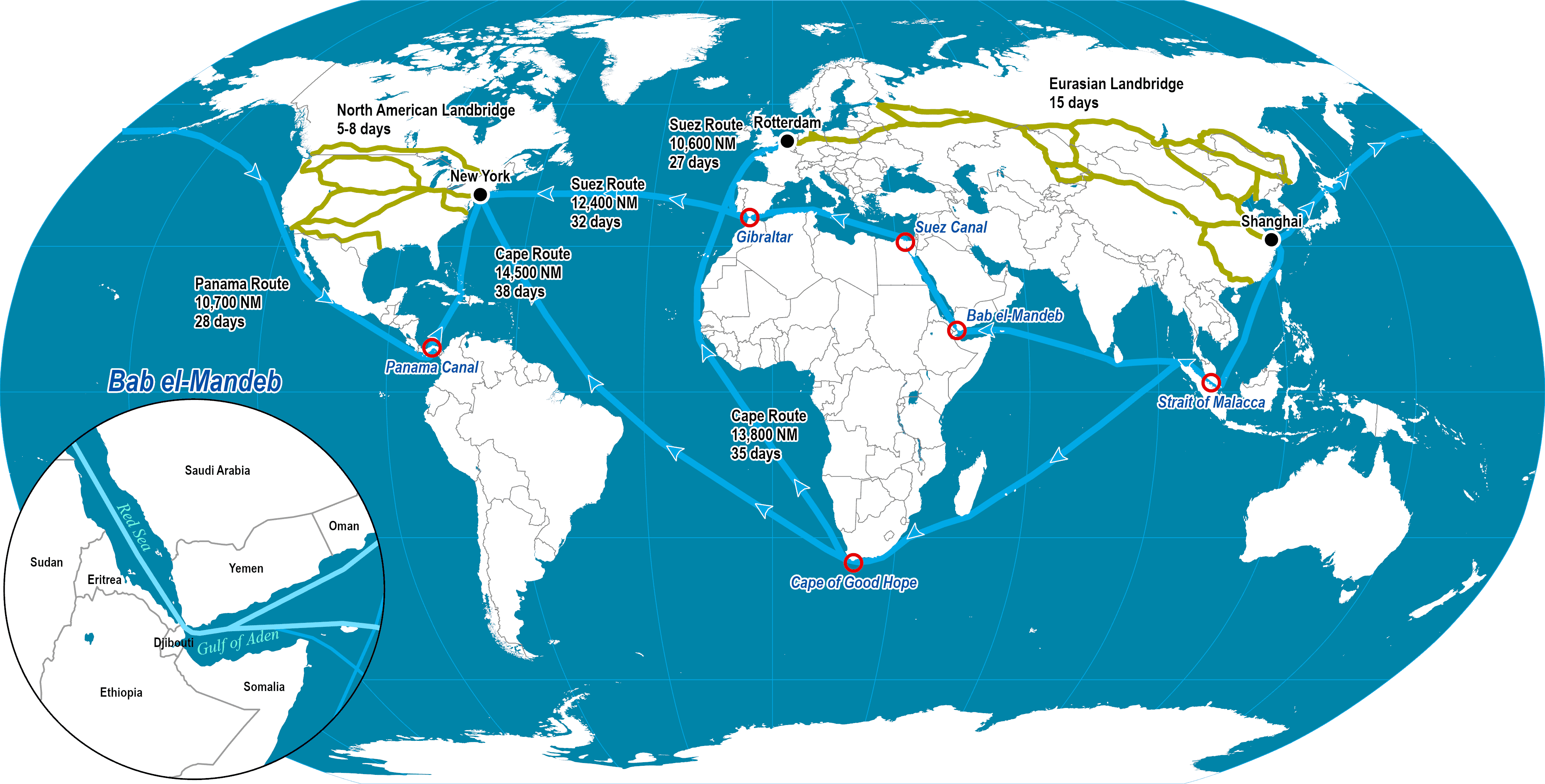

*Figure: Global shipping alternatives during the Red Sea crisis, showing the Suez Canal route via Bab el-Mandeb and the Cape of Good Hope diversion. Source: Port Economics Management.*