

7FNCE035W Assessment Brief
| Module title: | Financial Statement Analysis and Valuation |
| Module code: | 7FNCE035W (SEM2) |
| Assessment weighting: | 75% |
| Assessment type | Individual Coursework |
| Submission coursework: | 9 April 2026, Thursday, @ 13:00 UK time (submission to Blackboard) |
| Provisional marks and feedback: | 30 April 2026 on Blackboard |
| Feedback method: | Mixture of formative and summative assessment feedback |
Rationale for the coursework assignment
This coursework addresses Learning Outcomes (LO) 2,3, 4 and 6 of the Module. It is weighted at 75% of the students’ final grade on the module. Students will be assessed on their understanding of the topic as well as their ability to show proficiency when applying theory and practice to a range of situations encountered in business life.
The focus (An analyst report for investment purpose)
This Coursework is an investment report prepared by a financial analyst comparing two alternative firms in the same/similar industry for potential institutional investors to decide on which firm to invest in the long term. Such investors would like to be satisfied with the answer of mainly four questions before they make an investment decision, which this report will address
Assignment Outline
Given the focus explained above, students will individually answer the following four questions on Rolls-Royce Holdings Plc and BAE Systems Plc. Both firms are listed in the stock market (The detailed requirements for each question in line with the focus and marking criteria are provided further below).
1.Do the business strategies of the two firms differ? if so how/why? Critically evaluate.
2. What are the main drivers of these two firms’ Return on Equity (ROE) performance over the last there years? For this analysis, you must use the DuPont framework taught in the module, and critically assess your findings.
3. Do the income and cash flows performance of these two firms differ for the last three years? For this analysis, you must use Common sized income and Standardised cash flow statements taught in the module and critically evaluate your findings.
4. Do the payout policies (dividends and share repurchases) of the two firms differ for the last three years? For this analysis, you must also explore the theoretical aspect of dividends and critically analyse your findings
Word count: Maximum 3000 words (Abstract, bibliography, list of content, tables excluded). Students will allocate 300 words to Introduction and 150 words to Conclusion, 600 words to Q1, 650 words each to Q2, Q3 and Q4
Marking Criteria
(detailed Marking rubric is provided at the end)
| Criterion | Weight |
| Presentation
-Well organised, well structured, well written with style, -Correct grammar and spelling, -Clear understandable academic language. -Logical flow between sentences/paragraphs. -Effective use of tables/charts (titled, numbered, explanatory notes provided, sources acknowledged, currency, unit, %, etc., are clearly identified), -Relevant parts of annual reports are provided as appendices (Balance sheet, Income statement with page numbers), -Correct citing and acknowledging all sources in the text and at the end in a section headed as References. |
20% |
| Research
–Evidence of extensive and relevant reading from quality sources (use annual reports of the firm for financial data and reputable journal articles and recommended textbook for theoretical issues (Do not use Wikipedia, Investopedia, etc., Also, analyses on internet websites and firm data from investment websites can be misleading). -Evidence of extensive research on the firms’ business activities, -Proper collection of data, correct use and correct computation of figures and ratios as taught and studied in the module) |
30% |
| Analysis
– Analysis is insightful and supported by the data (Avoid narrating the decreases or increases of the data already observed in tables, that will be descriptive and brings lower mark. In contrast, provide articulate inferences based on evidence and reasoning), – Analysis is forward looking (Avoid talking on what happened in the past, but provide comments that feed future, your predictions and recommendations to investors), – Analysis is critical (Avoid talking only from one side, but give equal chance to opposite views. For instance, using only the firm’s narrative to explain an issue would be far from being critical, possibly leading to overoptimism; Instead, provide alternative explanations, potential risks taking also into account the economic environment). – The question is answered effectively (Focus only on the core question, stay relevant and provide a clear answer regarding the issue asked; An investor or reader forms a clear view about each firm once reading your answer with clear comparison). |
50% |
| TOTAL | 100% |
Detailed requirements for each question (in line with the marking criteria
Q1 Requirements:
You will try to identify the business risks and potentials of these two firms, and answer how satisfying isa firm’s business strategy given these risks and potentials comparing to alternative firms. This involves answering questions such as what is the core business and product(s)? What drive the prices of products and inputs? Is this a capital/technology/intellectual property driven business? What actions do firms take to survive to compete and grow? Have the business strategies worked so far given the financial outcomes?
Your business strategy analysis should not be general but specific providing relevant examples using the firm data, such that the analysis must distinguish the two firms in their business strategies and answer whether their strategies result in the expected outcomes, which can only be observed through numerical data (e.g., profits, revenues, cash flows, profit margins, dividend yields, share prices). You should start with answering what is the core business? (a firm can operate in more than one field and may have multiple products, but a robust analysis will reveal that sales are driven by one or two products only, which will narrow the analysis to relevant profit generating units. In answering this question, also focus on what they are known for? what are known products, brands? Has the firm a wide range customer base, is the firm region bound? etc.? You should avoid using the firms’ own narrative that normally sounds advertising, rather use critical approach mentioning risks etc., which helps more to the decision making process. For instance, have the business strategies been tested and applied and proven robust, and is there any concrete material evidence, i.e., really add value to firm? You should also do a brief industry analysis, market conditions including future expectations; what happens if commodity prices move sharply? Which company is affected most if prices change?
Talk forward looking on competitive advantages, risks (regulatory, environmental). What mechanism are put to deal with such risks? Avoid ending up incorrect conclusion (this happens (i) if the data set is incorrect or unverified and (ii) if the data set is not interpreted correctly. For any analysis, you should be spending some time for verifying the figures you use and some more time to think on what they mean for an investor). You should finally talk on which company would you advise to buy with respect to their business strategies. Remember, your analysis is a report intended to potential investors to make decision (A clear view about each firm after reading the answer).
Q2 Requirements.
You will answer How satisfying is the financial performance regarding the risk and return to the equity holder comparing to alternative? This involves answering questions such as what is the main driver of returns to equity? Is it the efficiency of business such as high turnovers, is it the sustainable core income, is it simply the outcome of high leverage?
You must use the following definitions in variable/data collection and calculations from the firms’ own annual reports (Do not use other information from the other internet sources such as analysis websites)
You will then report the data in a single table over three years for two firms showing also the numerators and denominators (an extract is below)
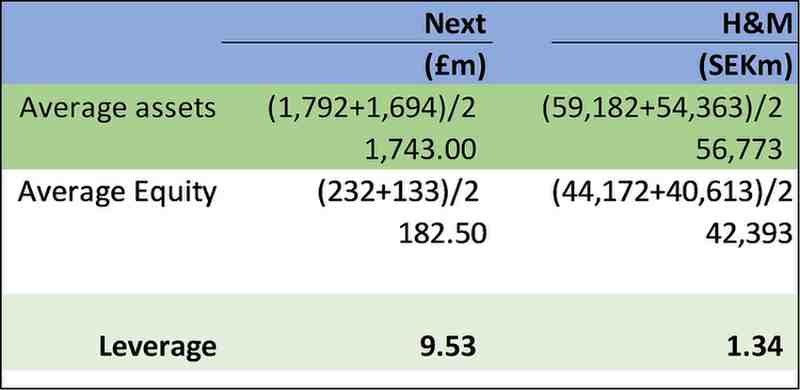
***You should put table number, table title, firm name, years covered, currency type. At the bottom of the table, you should also put the sources, notes, such as, provide page numbers of annual reports each year from which you get the data/figures as well as putting their links in the references at the end, so that a marker can confirm your figures by looking at the source).
In answering the question, you must address specifically what drives the ROEs for these two firms? Leverage? Profitability? Activity? and what are their sensitivities in the ROE? Your analysis must be informative rather than being descriptive (Descriptive means narrating the figures as increasing/decreasing that are already observed in tables). Try to talk relevant and materially important issues and figures, provide your opinion clearly which company you would advice to buy/sell/hold. Remember that, given the criteria set, this CW is essentially an analysis report with four questions, each investigating four fundamental investment issues that investors care very much; In this question, you will merely answer Is the ROE worth investing? You must distinguish the two firms with respect to their ROE drivers.
Q3 Requirements:
You will answer How satisfying are income and cash generating performance of the firm and their underlying drivers comparing to alternative? This involves answering questions such as Do Income and Cash flow come from core operation? Are income and cash flow sustainable? How do the income and cash performance compare with respect to accruals (for instance, high accruals in the net income indicate lower earnings quality, i.e., less persistence of earnings, less sustainable core earnings)?
First, you must prepare the ‘Common sized’ income and ‘Standardized cash flow’ statements as taught in the module, i.e., the cash flow and income statements should reflect the required analysis standards (Extracts of these tables are below).
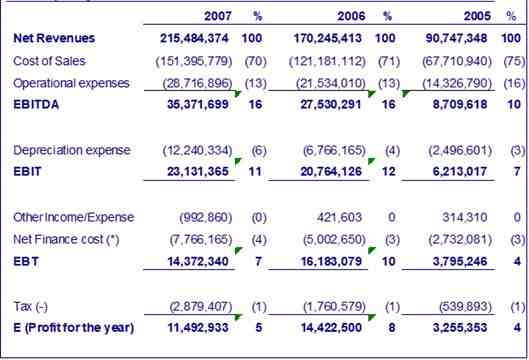
An extract for Standardized Cash flows statements (visit the relevant CF lecture)
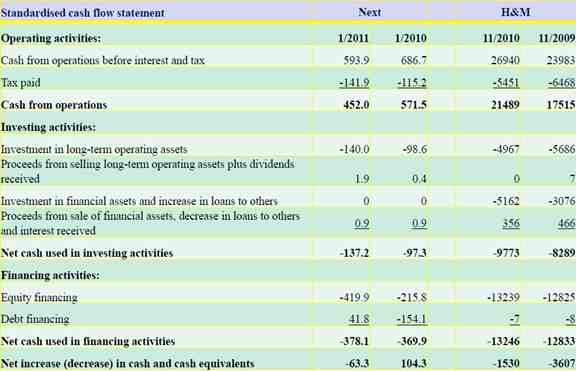
Where cash flow from operations are defined as the following
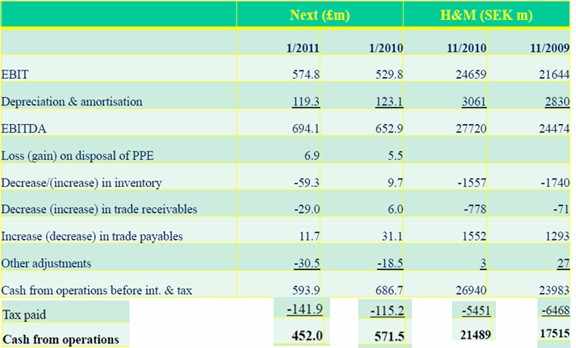
***you should put table number, title, firm name, years covered, currency type. At the bottom of the tables, you should also put the sources, notes, such as, provide page numbers of annual reports each year from which you get the data/figures as well as putting their links in the references at the end, so that a marker can confirm your figures by looking at the source).
Talk only on relevant and materially important issues/figures (Something is said to be material if it makes significant impact on the bottom line figures such as net income). Mentioning too many figures will be boring and distract the reader (Try to be refined with your figures and comments – for instance, if the ‘net income’ margin for a firm is less than 5%, but the other income’ margin shows 6%, this is a material issue to talk, meaning if there was no such other income, the firm would have reported losses). Overall, be careful interpreting figures not to end up incorrect and misleading conclusions. Again, avoid talking increases or decreases (avoid being descriptive), but talk on potential reasons of changes and how they can affect future prospects. You must distinguish the two firms with respect to their Income and Cash flow performance and provide a clear answer to the core question; An investor should be able to form a clear view about each firm as to which firm offers better prospects to invest with respect to income and cash expectations.
Q4 Requirements:
Here, you will answer how satisfying is the cash payout strategies (dividends and share repurchases) of the firm comparing to alternative. A firm may generate good returns on the paper such as high ROE, but if there is no payout or small payout given the alternative firm, investors may not be interested in that firm as they would like to capitalize their returns (‘cash is king’). This involves answering questions such as what is the dividend yield comparing to alternative investment? How frequently the firm pays out dividends or makes share repurchases? Do these payments make any effects on share prices? This issue in this sense involves also theoretical understanding of investor behaviour towards corporate payouts.
For a proper analysis, you should be spending some time to verify figures and some more time to think on what they mean for an investor (e.g., if you think that dividend strategies of firms are good, check whether the investors also think the same, which can be observed via share price movements around the dividend announcement dates. Such that if the dividend payments are thought to be favourable regardinrefdfrcg a firm’s future prospect, share price is likely to increase. Besides you must mention dividend related theory(ies) given the core question, that is ‘Do the dividend payout strategies of two firms differ? and do you think those strategies may affect investor behaviour? why? You should also check dividend yield, D(t+1)/P(t) over years (Had an investor invested £100 in these firms, how much dividends they would have received during the last there years and what are investors overall return from these shares?-buy and hold return – how this compares to ROE?). Investors need to be sure of these things before investing in a company. Overall, you need to distinguish the two firms with respect to dividend strategies and provide a clear answer to the question.
Marking
The University has arrangements for marking, internal moderation and external scrutiny. Further information can be found in Section 12 of the Handbook of Academic Regulations, westminster.ac.uk/study/current-students/resources/academic-regulations
Anonymous marking
Do NOT include your name or student number within the file name or anywhere within your submission. The submission will be subject to anonymous marking. Having logged into blackboard the system will record your details anonymously and tutors will only see your name after the entire submission has been assessed and provisional marks have been released to all students at the same time.
Referencing requirements for the assessment
Statements, assertions and ideas made in coursework should be supported by citing relevant sources. Sources cited in the text should be listed at the end of the assignment in a reference list. Any material that you read but do not cite in the report should go into a separate bibliography. Unless explicitly stated otherwise by the module teaching team, all referencing should be in CITE THEM RIGHT Harvard format. If you are not sure about this, the library provides guidance (available via https://www.westminster.ac.uk/current-students/studies/study-skills-and-training/research-skills/referencing-your-work).
The deadline and submitting your coursework – checks
Unless indicated otherwise, coursework is submitted via Blackboard.
It is a requirement that you submit your work electronically as a single file via Blackboard (BB) no later than 13.00 (that is, 1.00 p.m.) UK time on the due date. This means that your work should be fully uploaded before 13.00. The University would treat your submission as late, if your work has not been fully uploaded and stored on the server before 13.00. In order to avoid your submission being marked as late, you should upload your work as soon as possible before the deadline and must not wait until or just before the deadline to start uploading your work.
At busy times the coursework submission process may run slowly. To ensure that your submission is not recorded as a late submission, avoid submitting very close to the deadline.
To submit your assignment:
- Log on to Blackboard at http://learning.westminster.ac.uk;
- Go to the Blackboard site for this module;
- Click on the ‘Assessment’ in the middle of the content area
- Click on ‘Submit Coursework’, the relevant link will appear
- on Click on the link for the assignment;
- Follow the instructions.
It is a requirement that you submit your work in this way. All coursework must be uploaded by 13:00 (UK Time on the due date).
REMEMBER: If you submit your assessment late but within 24 hours or one ‘working’ day of the specified deadline, 10% of the overall marks available for that assessment will be deducted as a penalty for late submission, except for work which is marked in the marginal pass rate range (9% above the pass mark) and in this case the mark would be capped at the pass mark.
If you submit your coursework more than 24 hours after the specified deadline you will be given a mark of zero for the work in question.
Difficulties in submitting assignments on time
If you have difficulties for reasons beyond your control (e.g. serious illness, family problems etc.) that prevent you from submitting the assessment, make sure you apply to the Mitigating Circumstances board with evidence to support your claim as soon as possible. Further details can be found on the following URL: https://www.westminster.ac.uk/current-students/guides-and-policies/assessment-guidelines/mitigating-circumstances-claims
If you are unsure about the above information, you should seek academic support from your module leader, personal tutor or your course leader. You will find details of your module leader in this module’s handbook and you can find the name of your course leader and personal tutor from your “My Student Records” page via the University’s student portal.
ACADEMIC SUPPORT & FEEDBACK ARRANGEMENTS
Results are announced after 15 working days unless stated otherwise on Blackboard. University policy is to announce the feedback and marks 15 working days after the submission, but this duration may be shorter if all assessment processes finish early. A Mixture of formative and summative assessment feedback will be provided regarding the marks awarded.
For this assessment there will be opportunities for an academic support drop in sessions where you will receive support and feedback on your assessment prior to submission. Further details are provided in the module handbook. There will also be opportunities to receive academic support during lectures through allocated questions and answers sessions and through the discussion board on the module blackboard site.
After submission, summative feedback will be provided online via blackboard, where feedback takes the form of an indication of performance on the provided making grid. You will also receive a number on key points of strength, weakness and academic skills you can improve upon. We aim to provide you this feedback within 15 working days and after the feedback has been released online there will also be an opportunity to meet with marker for oral feedback in the first available academic support hours. If you are unsure about how to see your provisional marks and feedback, the following LINK will explain how you cand do this
General feedback for the entire module will also be made via blackboard to the module, which will discuss the key areas of shared strengths, weaknesses and academic skills improvements. This general feedback is likely to be issued before your specific summative feedback and we would strongly encourage you to read this feedback to improve your understanding of the module and potentially areas of weaknesses in your academic skills which you could develop before your next submission within your course.
Academic integrity
What you submit for assessment must be your own current work. It will automatically be scanned through a text matching system to check for possible plagiarism.
Do not reuse material from other assessments that you may have completed on other modules. Collusion with other students (except when working in groups), recycling previous assignments (unless this is explicitly allowed by the module leader) and/or plagiarism (copying) of other sources all are offences and are dealt with accordingly. If you are not sure about this, then speak to your class leader.
University of Westminster Quality & Standards statement
Plagiarism is a particular form of cheating. Plagiarism must be avoided at all costs and students who break the rules, however innocently, will be penalized. It is your responsibility to ensure that you understand correct referencing practices. As a University level student, you are expected to use appropriate references and keep carefully detailed notes of all your sources of material, including any material downloaded from the www.
Plagiarism is defined as submission for assessment of material (written, visual or oral) originally produced by another person or persons, without acknowledgement, in such a way that the work could be assumed to be your own. Plagiarism may involve the unattributed use of another person’s work, ideas, opinions, theory, facts, statistics, graphs, models, paintings, performance, computer code, drawings, quotations of another person’s actual spoken or written words, or paraphrases of another person’s spoken or written words.
Plagiarism covers both direct copying and copying or paraphrasing with only minor adjustments:
- a direct quotation from a text must be indicated by the use of quotation marks (or an indented paragraph in italics for a substantive section) and the source of the quote (title, author, page number and date of publication) provided;
- a paraphrased summary must be indicated by attribution of the author, date and source of the material including page numbers for the section(s) which have been summarized.
Get Step-by-Step Help for 7FNCE035W Coursework Today
The post 7FNCE035W Financial Statement Analysis and Valuation Assessment Brief (SEM2) 2026 | UOW appeared first on Students Assignment Help UK.