

SEL520 Why We Post: Social Media and Us Assignment Brief 2026 | Regent’s University London
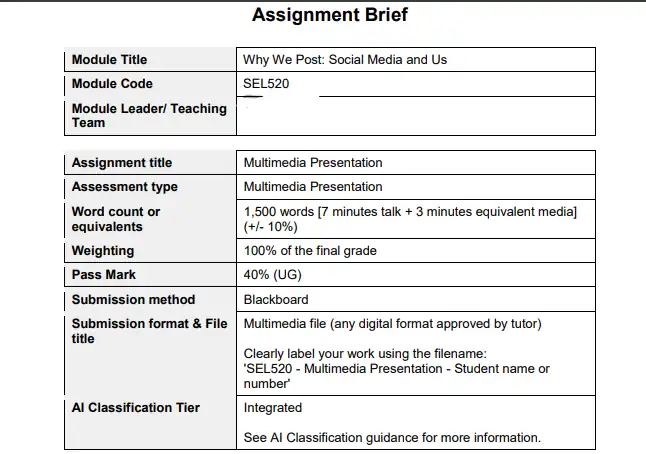
SEL520 Why We Post: Social Media and Us Assignment Brief
Learning Outcomes Assessed
- MLO1: Collaborate effectively in class and demonstrate active learning through media research
- MLO5: Apply digital tools and social media responsibly within the media landscape
- MLO6: Communicate effectively within social media and digital media in various formats and across multicultural contexts and audiences
Assessment Details
Aims & Objectives This module brings your experiences of social media, voices and personal stories into the classroom. You will gain critical exposure to interactive and interdisciplinary thinking and practices surrounding social media. Task You need to tell an immersive visual and digital story about how and why a chosen group/audience uses social media, from their point of view, and generate new content for them. The chosen group/audience needs to be different from your own background or culture. You can use any formats (wikis, microblogging, Instagram, Twitter, film, soundcast, metaverse, TikTok, blogs, or any other visual or social media) that reflect how this group or audience uses media. Further Details Using any digital format, you will design and develop multimedia for a chosen group, and you will present your research, analysis and multimedia (using Pecha Kucha presentation style) in class, in weeks 11 and 12. Your assignment requires that you do several things:
- Find a community
- Do some research on the community and their use of social media
- Using the community’s preferred media, you need to create up to 3 (no more) pieces of interactive media to generate new media for them (about 3 minutes long or 3 visual elements)
- Present your community, findings, social media, analysis and the media you will generate for them in a 7-minute presentation
- The presentation must be in the style of Pecha Kucha.
Pecha Kucha Presentation Style
Pecha Kucha is the art of concise storytelling and connecting with people through voice and multimedia. See: https://www.pechakucha.com What You Need to Know: Pecha Kucha is the art of concise storytelling, brought to connect with audiences through creativity, media and voice. You will practice this in class during formative sessions, and the tutor will provide you with many examples. So, How Do You Need to Present? Your final presentation must follow the Pechakucha style: In Pechakucha, you need to use 20 slides, and each slide is 20 seconds long. This is your challenge: you must have only 20 slides, and each slide is 20 seconds. Unlike PowerPoint, Pechakucha is fully visual. You will design 20 slides, using images (either collected during research, used with AI (provided it is relevant and supports the story, not just a decoration), or created by you, photographs, screenshots, images of your interactive media, including your interactive media). This presentation will prepare you professionally for a future where digital storytelling and media-visually displayed social media narratives (think memes, Instagram posts, TikTok reels) are key. You will gain new skills in visual storytelling, and you will bring your voice, style and approach to an audience, connecting with the hope of connecting with them. Many future employers consider PechaKucha a must-have skill in interactive storytelling, from media to marketing pitching, advertising, managing projects, professional presentations and any situation where you need to engage with an audience. The 7-minute (Pecha Kucha) presentation includes all the digital media (if your media includes a video 3 minutes long, this is additional to your 7-minute presentation at the end). Format: Pechakucha (20 slides x 20 seconds = 6 minutes 40 seconds) Content: For your presentation, you need to demonstrate an understanding of how and why the chosen group uses social media. This could involve motivations, protests, opinions, citizen journalism, cultural influences, preferred platforms, and distinct communication styles. You are telling a story through media and visuals, storytelling, video or other media to demonstrate how this group connects, shares and interacts online.
Pecha Kucha Structure
In Pechakucha you will tell your story of ‘why we post’ (why your group/community posts) in a creative storytelling of a 20×20 format. Every slide is 20 seconds, and can only contain basic visual media, no bullet points. You can put a title and then narrate the slide. It is about storytelling. Examples will be given in class.
The structure of the Pechakucha (20 slides):
Slides 1-5: Tell the story of the community and the research you carried out (First slide with your name and title, 2 slides on the community, 2 slides on the research) Slides 6-10: Tell the story of the use of media by this community, with examples, and consideration for the platform they use Slides 11-15: Critical analysis of the use of media, platform, technology, with theory (2 slides analysing the use of media, 2 slides with theories combined, 1 slide for references at the end of the presentation) Slides 16-20: Explain what media you will create for them, why, and final personal reflection on your learning journey At the end of your Pechakucha you can show us your media (this does not need to be explained again). The Pecha Kucha and the media can be uploaded to Blackboard and Padlet.
Content Details
Analysis of the chosen community and their social media formats using a critical approach and course (academic) literature For example, which angle/part of this community are you looking at (for example, ‘activism’ but specifically ‘youth’ or ‘celebrity’ activism)? What points have emerged through your research and analysis of the chosen community and their social media use? What theory may help you understand? At level 5, aim to go beyond description (who they are and what they do online) to analysis:
- Why do they do what they do?
- Why do they post?
- Why do they post that way?
- What does their practice tell us about how they are engaging with social media?
- What are the points of tension, politics of power, artifacts or narratives you can explore beyond the surface?
- How do they tell the story of their lives through social media?
- What does that story tell us?
- Who is the audience?
- Who is being ignored, left behind, included, or mentioned?
- What platform do they use and why?
Analytical Concepts to Consider: content impact, societal shifts, influence and identity, community, perception, network structures, algorithmic curation, sustained exposure, platform politics, motivations, entertainment, uses and gratification, self-presentation, memes, echo bubbles, social-groups representation, sharing of values (or confrontation), endorsement, trust, mutual benefit, collective or political action, social capital, priorities (political agendas), network effects, perspectives, interpretations of a platform, bias in media production or representation, isolation, fears, ideologies, gender, ethnicity, spectatorship, myths, content creation, use of mobiles and technology, power and surveillance, data use, audience reception, parasocial relationships, digital labour, authenticity, virality, remediation, convergence, participatory culture, filter bubbles, moral panics, digital divide, produsage/prosumer, affect, visibility/invisibility, gatekeeping, framing, discourse, semiotics. Using theory, you can elevate their story to give meaning to why they post and how they transform social media and their society through it. What You Need to Include
- Your Pecha Kucha presentation (20 slides x 20 seconds)
- Up to 3 pieces of interactive media created for your chosen community
- Research and in-text citations references
- AI tools and actual prompts in the AI log
- Reference list (in Pechakucha)
- Cover Sheet
Summative Assessment
Deadline to submit your presentation is Monday, 20th April at 12:00 midday. Work must be uploaded to Blackboard with a cover sheet included. Follow-up presentations will take place in classroom time in weeks starting 20th April and 27th April at the time of your usual session. Once you upload your presentations on April 20th, you may not make changes during the week or after your presentation or as a result of attending other people’s presentations. What Do I Need to Do to Pass? Obtain a grade of 40% minimum.
Marking Criteria
| Criteria | Band 0 (0-20%) | Band 1 (21-39%) | Band 2 (40-49%) | Band 3 (50-59%) | Band 4 (60-69%) | Band 5 (70-85%) | Band 6 (86-100%) |
|---|---|---|---|---|---|---|---|
| Collaboration and Active Learning | Does not answer the brief or is off topic or empty. There is no work in the presentation. | May refer to collaboration in class but with limited use of evidence and limited reference to specific activities or experiences. | Describes and evidences at least one example of collaboration in class and active learning and idea proposal. There is presence, in the presentation, of some collaboration. | Describes evidences and partly evaluates from within the collaborative work in class and shows one example of active learning (media research) on one social media platform and its communities or groups. There is presence of the student in the final presentation. | Describes, evidences and evaluates one social media platform as part of collective social experience and partially applies insights and presents socially-aware situations with regards to social media to a wider context of media, culture and society. Shows some limited use of socially critical situations, perhaps reduced to current use of the platforms but the proposal of the presentation has been considered against the social media context. There is clear effort in the digital skills (learning from the community you studied). | Describes, evidences and evaluates more than one example of social media and collaborative work in creating this assignment. Applies active learning and is able to consider the use of social media as different than they are today, where the final outcome suggests critical thinking. Shows socially engaged uses of media and social solutions. Ideas are clearly outside the box. The presentation demonstrates regular, critical and supportive class collaboration towards an effective presentation. | Evidences critical and complex insights about analysing social media. The individual research with a community contributes to maximum effect of an effective presentation, and wider demonstration of ownership of learning in relation to social media use. Shows originality beyond the expectations of the task in relation to media and social solutions, overall technical presentation of the work and design of the immersive media. |
| Knowledge and Use of Digital Tools | Does not make use of digital tools or is off topic or empty. | May refer to social media, digital environments but with limited exploration of any specific examples from the learning experience. | Describes and evidences at least one example of social media and attempts to evaluate why this tool was appropriate or not to become a more active learner. Evidence of work in the presentation that is personal contribution. | Describes and evidences use of at least one example of social media and partially uses digital tools and is able to evaluate why the social media platform or tool was appropriate; helping the student re-define initial ideas through digital media and partially applies critical theory to the use of these social media tools. | Describes and evidences use of at least one social media platform and one digital tool. Evaluates why these platforms and tools were appropriate for the chosen group/audience, or not, and partially applies socially critical insights to future adaptations of these tools. | Describes and evidences use of more than one social media platform and more than one digital tool with reference to ethical, cultural and issues around social media. Evaluates why these platforms were appropriate or not, able to identify challenges, contradictions and is able to respond to the social issues using or demonstrating the replication of the media (if, for example, the community or group uses instagram, the presentation may follow the instagram format, or be created for instagram). | Evidences and evaluates the use of several social media platforms and digital tools with reference to ethics, responsible use, issues around social media as spaces for transformation, discussions on political power and critical reflections on the course literature on digital media and tools. The individual applies creative use of digital media, social media in the wider context of the academic and professional development. |
| Reflection on the Study Area (Discipline/ Interdisciplinary) | No engagement with the course content, off topic or empty. | May address some ideas on social media but these are descriptive and generic with limited evidence of research or limited exploration of examples. | Describes and evidences at least one approach to applying social media to a specific chosen group/audience, with some consideration for what exists in social media platforms and the market. The analysis of social media is descriptive. | Describes and evidences at least one approach to social media as applied to the main chosen group/audience, reflecting on how these applications impact the outcome. The analysis of social media presents sides (or phrased as ‘the positive and negative of social media’). | Describes, evidences and evaluates at least one similar and one different approach to managing social media for social change, reflecting on why these differences arise and demonstrating some criticality in the application of these ideas to the final outcome. The analysis of social media is contextual beyond positive/negative overviews, has a sound use of theory. | Describes, evidences and evaluates more than one connection and divergence between disciplines in the context of approaches to social media. Is able to demonstrate ’emergence’ as a result of critically reflecting on how and why the various social media platforms impact the solution to the chosen group/audience. The analysis of social media is critical of the positive/negative approach and theoretically coherent, critical of theory, able to complement theories interdisciplinarily. | Evidences and evaluates several connections and divergences between disciplines in the context of approaches to social media. Is able to demonstrate curiosity about context and future use of social media. Applies insights gained to the values of multiple interconnections between social media and it is clearly interdisciplinary. It goes beyond expectations in showing how multiple perspectives can be applied to understanding the meanings that people give to social media in a critical and reflexive way. The analysis of social media is critical of the positive/negative approach and theoretically coherent, critical of theory, able to complement theories interdisciplinarily. |
| Communication | The media used is limiting, no commitment to telling a story. | Limited use of media technologies when telling the story, appears read and superficial. | The presentation may be produced in a general way with limited use of the technology, the format is too long or too short. The presentation can be understood, it may sound over performed but the message can reach the audience. | The presentation is clear, appears natural and has a good tone and a story telling approach that engages the audience. The media used supports the presentation to good effect. | Describes, evidences and evaluates at least one example of effective communication in various formats and one of addressing multicultural contexts, partially applying this to the presentation. The presentation is very good because the images, text, audio are very well presented, aesthetically meaningful, logic sequencing and is able to narrate a story about the community and their use of social media in a balanced way. The immersive media is strong and creative, perhaps using unusual media. | Describes, evidences and evaluates more than one example of approach to critically reflection on social media use by the given community/group, reflecting why these differences arise and demonstrating some criticality. The presentation is excellent because the narrative, story-telling is engaging at all levels, perfectly timed, clear and has a strong message that is able to convey complexity and criticality and empathy, grounded knowledge of the group. Is able to speak for the group balancing issues of representation and power. The immersive media enhances the presentation and it is done in the style of the group. | Evidences and evaluates multiple instances of effective communication in various formats across multicultural contexts and audiences with comprehensive critical elaboration and explanation. Is able to critically demonstrate complex articulation of social media use, critically reflecting on how and why various groups and social platforms impact each other, and how the groups/communities come to shape social media. The presentation is outstanding because story-telling is at near-professional level, it is engaging at all levels, perfectly timed, reflexive and personable, it has a strong message, one that is able to convey complexity, criticality and empathy and grounded knowledge of the group and their articulation of social media. Is able to speak for the group balancing issues of representation and power and may have advanced technical or immersive media that enhances the presentation at that level, and is done in the style of the group. |
| Work as a Whole | Off-topic, empty or generic, no engagement with core principles in social media. Very poor communication. No referencing of sources, and no referencing of AI prompting. No work in the presentation. AI is used uncritically to produce random ideas or generic images. No digital skills are present. No evidence of research work. | May refer to a presentation and may attempt to say something about social media but the exploration of concepts and evidence is limited. No relevant work presented, or last minute notes that evidence limited engagement. The presentation will not make much sense when presented. Poor AI prompting and poor referencing (or references and prompts missing or incomplete, or unexplored). AI is used uncritically to produce random answers or generic ideas. No new digital skills are demonstrated. Poor evidence of research, the work is mostly superficial description of a group’s media. The narrative could benefit from more critical engagement. | Describes and evidences a personalised use of social media, use of digital tools and knowledge or practice of these in society. Communicates reasonably clearly. The presentation text, images or audio can be understood but require use of notes for clear understanding of the concept. Use of PowerPoint (or other media) will be textual and bullet pointed without critical links. The work as a whole is mostly descriptive and there is no attempt to consider future differences of the social media, it is not reflexive. Sources are adequately referenced. Use of AI appears supported by prompts. Prompts are limitedly explored but makes sense in the context. There is evidence of transformation of prompts into personal interpretation or analysis. Too much dependence on AI beyond the needs of the brief. | Describes, evidences a personalised toolkit of digital skills, and knowledge of social media, and partly evaluates the needs of the presentation. The presentation can be understood perhaps with some aid of notes as background reference, but the concept is clear and evidenced visually or in writing. There are alternatives used to PowerPoint, and it is not too textual, there is a limit to bullet points. The work may be descriptive but there is attempt to consider alternative uses of the social media. Communicates the presentation clearly and presents the work professionally in most aspects. Sources are well referenced. Use of AI appears supported by prompts. Prompts are limitedly explored but makes sense in the context. There is evidence of transformation of prompts into personal interpretation or analysis. AI dependence is limited to the specifics of the brief. The student is able to present their individual voice and experience of social media but may be stronger than that of the community it represents. | Describes and evidences a personalised toolkit of digital and technical skills individually and socially (learning from the research group/community). Communicates very clearly the proposed concept and how they have arrived to it. Presents the work professionally, beyond the use of stale PowerPoints or generic use of AI generated images. The use of AI is critical, with changes to prompting and alteration of AI responses. AI dependence is limited to the specifics of the brief. Sources and prompts are referenced fully and accurately. The presentation is elegantly built, it is easy to navigate and enhances the presentation of the work. The presentation has a rich balance of media that can be understood without the need of additional prompts or supports. Watching the work is clear. The student has created good meaningful visual story of the group and social media used. The student has worked to present ideas towards an effective presentation. | Describes and evidences a personalised toolkit of digital and technical skills individually and socially (learning from the research group/community). Communicates very clearly the proposed concept and how they have arrived to it. Presents the work professionally, beyond the use of stale PowerPoints or generic use of AI generated images. The use of AI is creative, critical, and the prompts have been revised and used various times. Sources and prompts are referenced fully and accurately. The design of the media presentation is elegantly and professionally thought through, easy to navigate through the presentation with no technical glitches, and contributes to enhancing the presentation of the work. The work has a rich balance of media that elevates the pitch without any need to explore additional notes in order to understand the concept. The presentation demonstrates empathetic understanding of the studied community. The student has clearly worked to transform ideas towards an effective presentation but the digital skills for presenting work are of good quality and may include different software or sources that are not traditionally used for assignments or may reflect exploration of new social media skills. A critical reflection on learning may be found on the |